You need JavaScript enabled to view most of the content

Mixing Problems 1

Problem 1.
A tank contains $10$ L of water in which initially $y_0$ kg of salt is dissolved. Brine runs in $2$ L per minutes containing $30$% of salt per liter and runs out $2$ L per minutes. The mixture in the tank is kept uniform by stirring.
(a) Determine the amount of salt $y(t)$ in the tank at all times $t>0$.
     Show that $\displaystyle{\lim_{t\to\infty}}y(t)=y_{*}$ independently of $y_0$ where $y_{*}$ is the     equilibrium solution of the problem.
(b) If initially there is no salt in the tank, i.e., $y(0)=y_0=0$, determine $y(5)$.

Population Models 1

Problem 1.
The model is \[ y'(t)=Ky(t)(M-y(t)), \] where $K,M>0$ are constants. Determine the general solution if the initial value is $y(0)=y_0>0$.

Pendulum 1

Problem 1.
Describe the motion of the simple pendulum.

Heating and Cooling 1

Problem 1.
If the temperature of the bread is $120^oC$, of the air is $30^oC$ and $K=0.0366$, determine the temperature of the bread $60$ minutes later.

Electric Circuits 1

Fig.1. RC-circuit.


Problem 1.
Determine $I(t)$ for
(a) a constant electromotive force,
(b) a periodic electromotive force,
if $I(0):=I_0$ is given.

Free Falling 1

Problem 1.
An object (its mass is $m$) falls through the air toward Earth. Assuming that the only forces acting on the object are gravity ($g$ is the gravity constant) and air resistance (proportional to the the speed of the object).

(a) Determine the speed $v(t)$ of the object.
(b) Show that $\displaystyle{\lim_{t\to\infty}}v(t)=v_{*}$ independently of the initial speed $v_0$, where $v_{*}$ is the equilibrium speed.

Electric Circuits 2

Fig.2. RLC-circuit.


Problem 2.
Determine $I(t)$ for
(a) a constant electromotive force,
(b) a periodic electromotive force,
if $I(0):=I_0$ and $I'(0)=I_0'$ are given.

Free Falling 2

Problem 2.
An object (its mass is $m$) falls through the air toward Earth. Assuming that the only forces acting on the object are gravity ($g$ is the gravity constant) and air resistance (proportional to the square of the speed of the object).

(a) Determine the speed $v(t)$ of the object.
(b) Show that $\displaystyle{\lim_{t\to\infty}}v(t)=v_{*}$ independently of the initial speed $v_0$, where $v_{*}$ is the equilibrium speed.

Electric Circuits 3

Problem 3.
Determine the particular solution $I_p(t)$ of the equation ($L,R,C,\gamma\gt 0$) \[ LI''(t)+RI'(t)+\frac{1}{C}I(t)=E_0e^{-\gamma t}. \]

Chemical Reactions 1

Problem 1.
The functions $x(t)$ and $y(t)$ describe the concentration of two substances, respectively. The first component transforms into the second one with the rate coefficient $k\gt 0$, and the second component decomposes at the rate $\mu\gt 0$. Describe the system.

Chemical Reactions 2

Problem 2.
The functions $u(t)$ and $v(t)$ describe the concentration of two substances, respectively. The components transform into each other with the rate coefficient $k\gt 0$, and the following system describes the process \begin{align*} u'(t)&=ku(t)v(t),\\ v'(t)&=-ku(t)v(t). \end{align*} For the sake of simplicity let $k:=1$, and $u(0),v(0)=1$. Approximate the solutions by 3rd order polynomials.

Solow growth model in economics

The Solow Model - Introduction

Problem 1.

Production function: \[ Y=F(K,L) \] $\textbf{Y}$: output, $\textbf{K}$: capital stock, $\textbf{L}$: labour force \[ k=K/L \] $\textbf{k}$: capital/labour ratio \[ y=Y/L \] $\textbf{y}$: output/labour ratio \[ \frac{Y}{L}=\frac{F(K,L)}{L}=F\left(\frac{K}{L},1\right)=F(k,1)=f(k) \] \[ y=f(k) \] \[ f(0)=0,\;f'(k)>0,\;f''(k)<0,\;k>0 \] Assumptions: \[ \dot{L}=nL,\;L(0)=L_{0} \] $\textbf{n}$: constant growth rate of labour force \[ S=sY \] $\textbf{S}$: savings as a constant fraction of output \[ S=I \] $\textbf{I}$: investment, which is the change in the capital stock plus replacement investment: \[ I=\dot{K}+\delta K \] \[ K(0)=K_{0} \]

Force Field 1


Problem 1.
A force field given by \[ \mathbf{F}(x,y)=\frac{2y}{\sqrt{x^2+y^2}}\mathbf{i}-\frac{y^2-x}{\sqrt{x^2+y^2}}\mathbf{j}. \] Draw it by finding and sketching the family of curves tangent to $\mathbf{F}$.

Secretion of Hormones 1


Problem 1.
The secretion of hormones into the blood is often a periodic activity. If a hormone is secreted on a $24$-hour cycle, then the rate of change of the level of the hormone in the blood may be represented by the initial value problem \[ x'(t)=\alpha-\beta \cos\left(\frac{\pi t}{12} \right)-kx(t), \qquad x(0)=x_0, \] where $x(t)$ is the amount of the hormone in the blood at time $t$, $\alpha$ is the average secretion rate, $\beta$ is the amount of daily variation in the secretion, and $k$ is a positive constant reflecting the rate at which the body removes the hormone from the blood.
If $\alpha,\beta=1$, $k=2$, and $x_0=10$, solve for $x(t)$.

Pendulum 2

Problem 2.
Approximate the motion of simple pendulum in case of $\theta(0)=0$, $\theta'(0)=v$.

Hanging chain 1

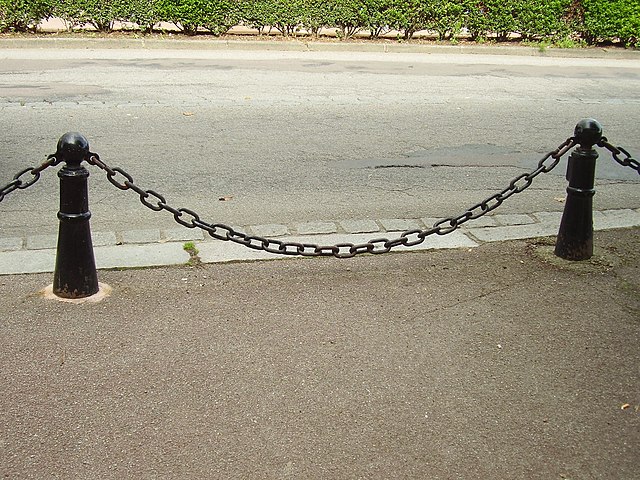
Hanging chain

Fig.1. A hanging chain.


Keleti Railway Station (Budapest, Hungary)

Fig.3. Keleti Railway Station (Budapest, Hungary).


Problem 1.
Determine the shape of a hanging chain.

Heating and Cooling 2

Problem 2.
If the temperature of the bread is $120^oC$, of the air is $30^oC$ and $K_1=0.0366$, $K_2=-0.0002$ determine the temperature of the bread and air $60$ minutes later.

Population Models 2

Problem 2.
Denote $x(t)$ the amount of fish in a lake. Assume the exponential growth model, $x'(t)=K x(t)$, $x(0)=x_0$. How do we set the fishing quota $H>0$ if we want $x(t)$ to be positive for $t>0$?