You need JavaScript enabled to view most of the content
Showing posts with label separable. Show all posts

Mixing Problems 1

Problem 1.
A tank contains $10$ L of water in which initially $y_0$ kg of salt is dissolved. Brine runs in $2$ L per minutes containing $30$% of salt per liter and runs out $2$ L per minutes. The mixture in the tank is kept uniform by stirring.
(a) Determine the amount of salt $y(t)$ in the tank at all times $t>0$.
     Show that $\displaystyle{\lim_{t\to\infty}}y(t)=y_{*}$ independently of $y_0$ where $y_{*}$ is the     equilibrium solution of the problem.
(b) If initially there is no salt in the tank, i.e., $y(0)=y_0=0$, determine $y(5)$.

Population Models 1

Problem 1.
The model is \[ y'(t)=Ky(t)(M-y(t)), \] where $K,M>0$ are constants. Determine the general solution if the initial value is $y(0)=y_0>0$.

Heating and Cooling 1

Problem 1.
If the temperature of the bread is $120^oC$, of the air is $30^oC$ and $K=0.0366$, determine the temperature of the bread $60$ minutes later.

Free Falling 1

Problem 1.
An object (its mass is $m$) falls through the air toward Earth. Assuming that the only forces acting on the object are gravity ($g$ is the gravity constant) and air resistance (proportional to the the speed of the object).

(a) Determine the speed $v(t)$ of the object.
(b) Show that $\displaystyle{\lim_{t\to\infty}}v(t)=v_{*}$ independently of the initial speed $v_0$, where $v_{*}$ is the equilibrium speed.

Free Falling 2

Problem 2.
An object (its mass is $m$) falls through the air toward Earth. Assuming that the only forces acting on the object are gravity ($g$ is the gravity constant) and air resistance (proportional to the square of the speed of the object).

(a) Determine the speed $v(t)$ of the object.
(b) Show that $\displaystyle{\lim_{t\to\infty}}v(t)=v_{*}$ independently of the initial speed $v_0$, where $v_{*}$ is the equilibrium speed.

Hanging chain 1

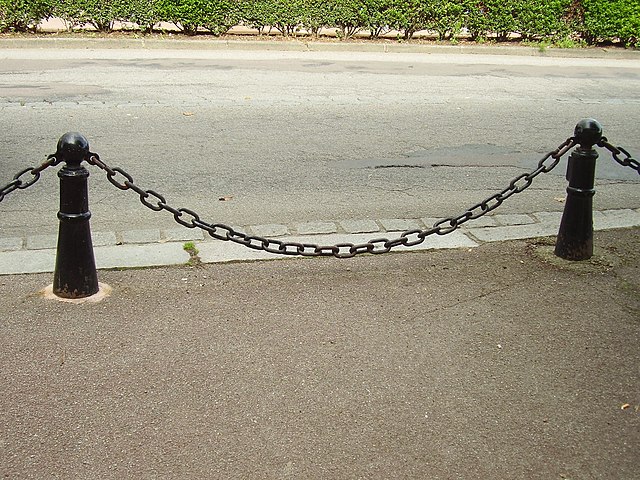
Hanging chain

Fig.1. A hanging chain.


Keleti Railway Station (Budapest, Hungary)

Fig.3. Keleti Railway Station (Budapest, Hungary).


Problem 1.
Determine the shape of a hanging chain.

Population Models 2

Problem 2.
Denote $x(t)$ the amount of fish in a lake. Assume the exponential growth model, $x'(t)=K x(t)$, $x(0)=x_0$. How do we set the fishing quota $H>0$ if we want $x(t)$ to be positive for $t>0$?